Health Promotion
Advisory resources for strategy, governance, policy design, and implementation
impact through alignment
Many jurisdictions are facing the same pattern: rising chronic disease, growing mental health strain, aging populations, workforce pressure, widening inequities, and overwhelmed medical systems. These pressures are often treated as problems of medical capacity alone. Yet many of the conditions that shape health lie outside medical service delivery, in the places where people are born, grow, learn, work, age, relate, and participate in society.
We have known for decades that health cannot be achieved only by treating illness after it appears. But governance, funding, incentives, and delivery models have often remained concentrated downstream. The result is a familiar cycle: public systems spend more, medical systems remain under strain, and the broader conditions that produce health remain fragmented across sectors, jurisdictions, and institutions.
Governments have an essential role, but they cannot produce health alone. Health is shaped by individuals, families, schools, workplaces, communities, civil society, the private sector, medical systems, governments, and other institutional actors. What has often been missing is not awareness or good intention. It is alignment: a practical way to connect outcomes, contributors, evidence, policy, and implementation across the life course.
That is why this work matters.
Health promotion is not a new idea. Since the 1970s and 1980s, major reports, international declarations, public-health leaders, and reform efforts have recognised that health is shaped by much more than medical care. Health is not simply the absence of disease. It is a resource for everyday life, shaped by social, economic, developmental, environmental, cultural, and institutional conditions.
Yet while our understanding of health has evolved, many systems have struggled to organise around that understanding. Medical service delivery remained structurally dominant. Health promotion was often acknowledged in principle, but left secondary in governance, funding, accountability, and implementation. Efforts remained scattered across programmes, pilots, policy statements, and sector-specific initiatives.
The difficulty has not been a lack of ideas. It has been the absence of a durable architecture for aligning action across the places where health is actually produced.
The Health Promotion Alignment Framework was developed to help close that gap. It provides a structured way to connect positive health outcomes, influencing factors, contributor domains, and evidence-based strategies across the life course, while allowing jurisdictions and institutions to adapt implementation to their own context.
The Health Promotion Alignment Framework and related materials are made available to support policy dialogue, mandate development, strategic planning, institutional alignment, and implementation related to health promotion.
The White Paper and all associated documents and materials may be shared, adapted, or reproduced, in whole or in part, for non-commercial internal government, policy, planning, academic, or public-interest purposes, provided clear and appropriate attribution is given to the author. Any external publication, reproduction, distribution, commercial use, incorporation into branded products or services, or public-facing adaptation of any kind requires prior written permission from the author.
The Framework and related materials were developed by Marc Dupont, Founder and Principal of Lac Meech Strategies. Marc is a policy strategist, governance practitioner, and framework architect whose work spans the public, private, and non-profit sectors. His work has included advising the House of Commons Standing Committee on Health, contributing to Canada’s response to the United Nations Framework Convention on Tobacco Control, leading major pan-Canadian policy and consultation initiatives, co-founding and leading a consulting firm responsible for more than 500 projects, and serving in senior leadership and advisory roles within the Government of Canada.
For inquiries related to the Health Promotion Alignment Framework, related materials, or advisory support, Marc can be reached through the contact page.
what's available
The Health Promotion Alignment Framework is a practical governance architecture designed to help jurisdictions and institutions move from broad recognition of health promotion to more coherent policy, planning, implementation, and measurement.
The resources available here include the foundational White Paper, along with visual references, applied policy tools, and strategic framing documents. They can be used individually or as part of a broader advisory, planning, or implementation process.
Some of the supporting materials were originally developed in the Canadian context and are retained here as examples of how the Framework can inform mandate development, intergovernmental planning, policy direction, strategic communication, and implementation in a specific jurisdictional setting. They are not presented as a single prescribed model for all jurisdictions.
These resources are intended for governments, public institutions, policy leaders, senior executives, researchers, civil society organisations, elected officials, communications teams, and cross-sector partners working to strengthen health promotion alignment.
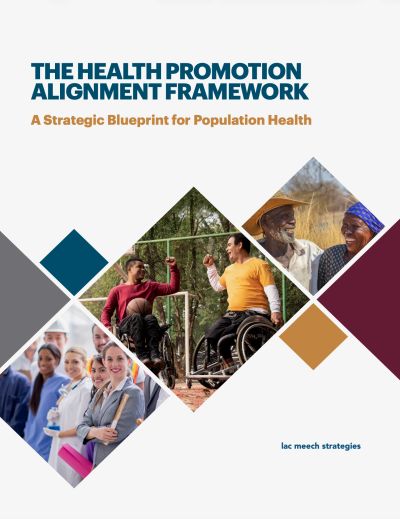
foundational reference & evidence base
This foundational resource presents the intellectual, strategic, and operational foundation of the Health Promotion Alignment Framework. It is provided to support executive briefings, cross-sectoral alignment, policy development, institutional orientation, and long-term planning.
The Health Promotion Alignment Framework – White Paper
The foundational document presenting the full Framework, including its rationale, historical and international context, core components, fixed and flexible elements, and implementation pathway. It sets out the case for moving health promotion beyond fragmented programmes and rhetorical endorsement toward positive outcomes, contributor-domain alignment, evidence-based strategies, and durable institutional implementation.
applied policy and implementation materials
These materials show how the Framework can inform policy direction, mandate development, implementation planning, and coordinated action in a specific governance context.
The Canada Health Promotion Action Plan below was originally developed as a Canadian application of the Framework. It illustrates how health promotion alignment can be translated into national-level policy direction while respecting jurisdictional roles, existing institutional responsibilities, and the need for practical implementation pathways.
Additional supporting materials and briefings may be available to support orientation, internal planning, policy adaptation, facilitation, or implementation contexts.
Canada Health Promotion Action Plan
An illustrative national-level application of the Framework, positioning health promotion as integral to long-term economic resilience, equity, public value, and population well-being. Includes implementation, tactical, and measurement considerations.
framing, briefing, and narrative tools
Documents in this section provide strategic language and conceptual framing to support internal briefings, mandate development, stakeholder engagement, interdepartmental alignment, and public-facing communication. These tools help position health promotion clearly and persuasively for different audiences and decision contexts.
Policy Brief
A concise, non-partisan briefing document summarising the Framework and its policy relevance. Suitable for orientation, onboarding, senior briefings, ministerial preparation, and strategic discussion.
Communications Reference Guide
A framing and messaging resource with language, narrative tools, and sample formulations to support internal communication, stakeholder engagement, and public understanding of health promotion alignment.
Primer
A short overview of the strategic value of health promotion alignment, why it matters now, and what a more coordinated approach requires.
Infographic
A one-page visual summary of the Framework’s alignment structure and six core components: life course, developmental transitions, positive outcomes, influencing factors, contributor domains, and effective strategies.
❞
“I was thoroughly impressed with the innovative multi-sectoral alignment framework for Health Promotion that Marc developed and feel that it is a major contribution to the field of health promotion and to Canada. I was also impressed by his leadership and communications skills, as well as his ability to organize and lead cross-country expert key informant working groups on the Framework.”
Irving Rootman, Author, Health Promotion Researcher and Professor,
University of British Columbia, Canada
Copyright © 2026 Lac Meech Strategies - All Rights Reserved.